Under contract with the US Federal Transit Administration, MagneMotion is developing a Maglev transport system with the ultimate intent of providing 100 mph transit service in urban settings. As part of the Urban Maglev initiative, MagneMotion is now in the full scale, proof-of-concept phase and is constructing a test track at its facility in Devens, Massachusetts. After the initial phase at MagneMotion, the Maglev vehicles will be shipped to Norfolk, Virginia for testing on an existing elevated guideway at Old Dominion University (ODU) that will be outfitted with MagneMotion's Maglev levitation, propulsion and control system. As a project team member, ODU is collecting data to generate ridership models, creating a simulation to predict ride quality and assisting in the design of the track and development of installation techniques that will be used both at MagneMotion and ODU.
To facilitate this test program, two concrete beams totaling 160 feet in length were delivered to MagneMotion to complete construction of a Maglev guideway system configured to replicate the existing guideway structure at ODU. There are two main parts to the guideway system, the columns and the beams. The columns were cast in place inside the MagneMotion test facility and are supported by a concrete footing 8' x 8' x 2' thick. For ease of working on the system at MagneMotion, the columns were designed to support the beams at a height of 5' above the floor. Hoyle, Tanner & Associates of Manchester, NH were contracted to complete the design of the beams, capable of supporting a 10 ton MagneMotion Maglev vehicle traveling at speeds of up to 10 m/s (22.3 mph).
The beams were made using the pre-stressed concrete casting method. Because of the small quantity and their unusual shape, it was difficult to find a company to cast the beams. MagneMotion identified Strescon, Ltd. in Saint John, New Brunswick, Canada to construct the beams. Working with HTA, Strescon built, tested and delivered the beams to MMI in March.
At their widest point, the beams are 4' 10" wide and the overall height of a beam is 3' 8" tall. Covering a span of 80 feet, each beam weighs 74,000 pounds with threaded studs along the top to secure the track to the concrete guideway. The beams rest on elastomeric bearing pads to duplicate the conditions that exist at ODU. These beams are somewhat larger than would be used in an operational MagneMotion Maglev system, but are sized to match the existing beams already installed at ODU. In its final form, the MagneMotion Maglev (M3) system will use individual, smaller, lighter vehicles about the size of a bus rather than long, heavy trains which alleviates the need for massive beams and an oversized elevated guideway structure.
After completing one year of design, construction, and control integration, MagneMotion can demonstrate the feasibility of a fully operational maglev system. The track and sled are mounted onto a 48 meter long concrete guideway structure which duplicates the infrastructure at ODU, allowing for an easy transition to operating on the university campus. Although the test track is indoors, the system has been designed to meet the expected weather conditions at ODU.
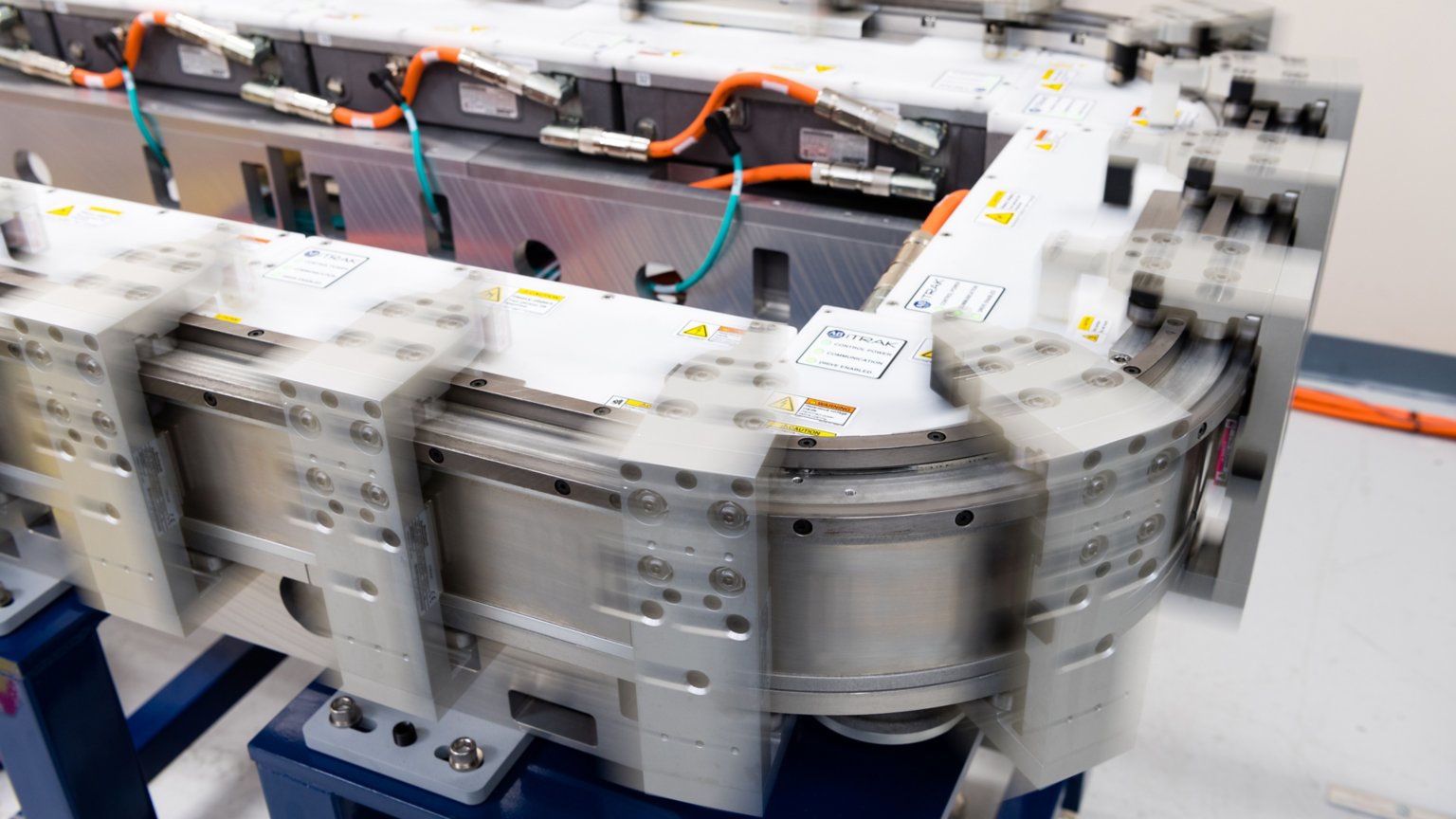
The major elements of the system have been designed and documented. Each motor and track assembly weighing nearly 4 tons have been assembled, tested, and mounted onto the concrete guideway. Joints have been designed to accommodate thermal expansion expected at the ODU installation.
MagneMotion has designed a sled or vehicle platform to travel along the guideway. This sled is approximately 11 ft wide and 9 ft long. Although not designed to shuttle passengers safely, the sled has been sized to hold up to 18 passengers. When fully loaded, the sled, at a weight of nearly 10 tons, will be operated on the MagneMotion test track. Demonstration of propelling the sled at speeds up to 22 mph will be done. Phase 1 Testing of the system is scheduled to be complete by October 2010.
Models to predict the ride quality have been generated and the testing will be used to determine compliance with general ride quality standards. Special attention has been paid to the impact of various wind gusts. The system and tests demonstrate that the transition to a fully operational people carrying system utilizing MagneMotion's M3 maglev technology can be a reality and can address the needs of urban transportation requirements.
To watch a video of the MagneMotion Maglev system in action, please click on the image below.

|